
Almost every boot adidas makes for rugby is a soft ground boot, which is why the letters SG appear on so many of the rugby boots in the range. It is rarely explained, and it is the single most important thing to get right — a boot matched to the wrong surface grips worse and wears faster.
This guide explains what soft ground means, how the stud types differ across the adidas range, and the one boot that is not SG.
What soft ground actually means
A soft ground boot is built for soft, wet natural grass — the surface most UK club rugby is played on from October through March.
The soleplate carries fewer, longer studs than a firm ground boot. Fewer studs concentrate the player's weight onto a smaller area, so each one penetrates the surface instead of sitting on top of it. On a heavy winter pitch that is the difference between biting into the ground and skating across it.
The trade-off is that the same design works against you on hard ground, where longer studs cannot penetrate and push back into the foot instead.
Metal, moulded or removable
Not every soft ground boot uses the same studs, and adidas mixes the types across the range.
Metal studs appear on the RS15 Elite and on both women's models, the RS15 Rise and the Avaglide. Metal penetrates genuinely soft, muddy ground more effectively than plastic, which is why it turns up on match-day boots rather than training ones.
Moulded studs are used elsewhere in the range, including on the firm ground models. They are lower maintenance and suit ground that is soft but not waterlogged.
Removable studs feature on the junior boot, where the studs unscrew and can be replaced. That is worth knowing for a growing player, because studs wear out long before the rest of the boot does.
Stud count: six or eight
The other difference is how many studs, and that follows the line rather than the surface.
The Kakari forward boots use an eight-stud outsole — a split outsole on the standard model and the Elite, and a lightweight one-piece design on the RS. The extra studs spread load and give more anchor points for scrummaging.
The RS15 speed boots use a six-stud layout, which is lighter and rotates more freely when a player cuts.
Our RS15 vs Kakari comparison covers which line suits which position.
A note on artificial grass
Neither soft ground nor firm ground boots are designed for artificial surfaces. Before playing on 3G or 4G, check adidas' own guidance on what surfaces each boot is intended for — using a boot outside the conditions it was built for affects both the boot and your grip, and many clubs have their own rules about studs on artificial pitches.
Compare adidas soft ground rugby boots
We track the adidas range across the UK retailers we work with, so you can see which sizes are in stock and what each model is selling for right now.
 Adidas Adizero RS15 Pro Soft Ground Rugby Boots – Junior – Core Black/Spark Yellowfrom £73.35
 Adidas Soft Ground Rugby Boots – Junior – Core BlackNo offers today
 Adidas Adizero RS15 Ultimate Soft Ground Rugby Boots – Junior – Core Black/Zerofrom £46.80
 Adidas Rugby Soft Ground Rugby Boots – Light Blue/WhiteNo offers today
 Adidas Junior Soft Ground Rugby Boots – Black/Greenfrom £34.99
 Adidas RS15 Soft Ground Rugby Boots – Core BlackNo offers today
 Adidas RS15 Elite Soft Ground Rugby Boots – White/Blackfrom £82.99
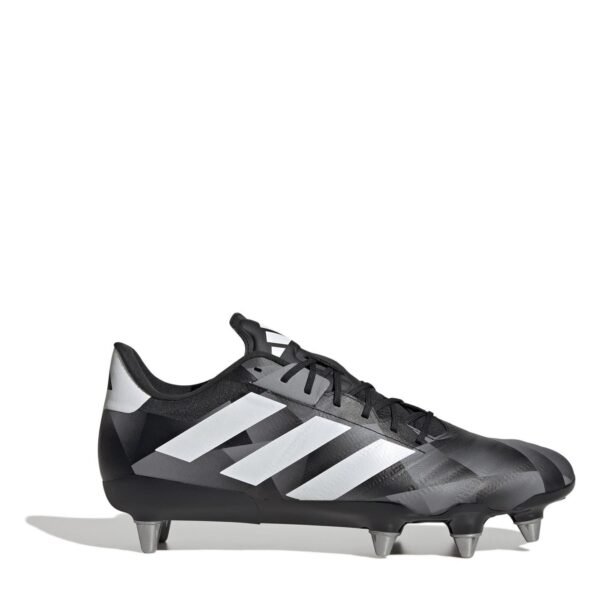 Adidas Kakari RS Soft Ground Rugby Boots – Black/Whitefrom £96.50
Frequently asked questions
What does SG mean on adidas rugby boots?
Soft ground. It means the boot is built for soft, wet natural grass, with fewer, longer studs that penetrate the surface rather than sitting on it.
Are all adidas rugby boots soft ground?
Most of them. The firm ground versions we track are the standard RS15 and the RS15 Pro, which use moulded angular studs for dry, hard pitches.
Which adidas rugby boots have metal studs?
The RS15 Elite, and both women's models — the RS15 Rise and the RS15 Avaglide. Others in the range use moulded studs, and the junior boot uses removable ones.
Can I wear soft ground boots on a dry pitch?
It is not what they are built for. Longer studs cannot penetrate hard ground and push back into the foot instead. A firm ground boot is the right tool for dry pitches.
Can I wear adidas soft ground boots on 3G?
Check adidas' guidance first, and your club's rules. Soft ground boots are designed for natural grass, not artificial surfaces.
Related guides
- Firm Ground vs Soft Ground Rugby Boots
- adidas RS15 vs Kakari
- The adidas RS15 range explained
- How to Choose Rugby Boots
RugbyDeals helps you compare prices across the retailers and products we feature on our site. Prices and stock can change, so always confirm the final details on the retailer's site before buying. Our content is for general information only and isn't safety, medical or buying advice — always follow the manufacturer's guidance and speak to a professional where it matters. We may earn a commission when you buy through our links, at no extra cost to you.