
If you are looking for the best adidas rugby boots for forwards, the answer is the Kakari line. adidas builds it specifically for the forward line, and the rugby boots in it are engineered around traction, stability and surviving contact rather than outright speed.
This guide explains what makes a boot right for a forward, which Kakari tier suits your level, and where the back row sits.
What forwards actually need
A forward generates and absorbs force. A prop pushing in the scrum, a lock cleaning out a ruck and a number eight hitting contact all need the boot to hold the ground and support the foot under load. Outright weight matters far less than it does on a wing.
That translates into three things:
- Traction — grip that holds when you are driving rather than sprinting.
- Stability — a wider platform that resists rolling under sideways load.
- Durability — an upper and sole that survive being stood on every week.
Why eight studs
The defining feature of the Kakari line is its eight-stud outsole. Most speed boots use six.
Those extra two studs sit under the midfoot and do two jobs: they spread the load across more contact points, and they give more anchor into soft ground. When you are transferring pushing power through a scrum, that is exactly what you want. A six-stud layout is lighter and rotates more freely, which suits a player changing direction constantly — and works against a player trying not to move at all.
Our guide to the best rugby boots for a forward covers stud configuration across all brands.
Which Kakari suits you
| Tier | Built for | What you get |
|---|---|---|
| Kakari | New players, junior forwards, value | Synthetic leather upper, eight-stud split outsole, 20% recycled materials |
| Kakari Elite | The regular club forward | Imitation leather upper, internal support system, forefoot stitching for ball grip |
| Kakari RS | Elite and semi-professional forwards | Reinforced Fusionskin leather upper, lightweight one-piece outsole |
The standard Kakari gives you the full eight-stud platform without premium materials — the sensible pick if you are new to the front five or buying for a growing player.
The Elite adds an internal support system for stability under load and a softer upper that beds in faster. This is the tier for someone playing and training most weeks.
The RS changes the construction rather than the trim: a one-piece outsole instead of a split one, and a Fusionskin leather upper reinforced where forwards take the most punishment. It is built to cut weight without giving up support.
Full detail on each is in our guide to the adidas Kakari range.
Where the back row sits
Flankers and number eights are the genuine grey area. They scrummage and hit contact like the tight five, but cover ground closer to a back.
The honest answer is that it depends on your game. If you are carrying, cleaning out and pushing, the Kakari's extra studs earn their place. If you are covering the width of the pitch and chasing kicks, the lighter six-stud RS15 line will suit you better. Our RS15 vs Kakari comparison sets the two side by side.
Compare adidas Kakari prices
We track the Kakari range across the UK retailers we work with, so you can see which sizes are in stock and what each model is selling for right now.
 Adidas Kakari Elite Rugby Boots – Neon YellowNo offers today
 Adidas Kakari Elite Soft Ground Rugby Boots – Black/SilverNo offers today
 Adidas Kakari Elite Soft Ground Rugby Boots – Lucid Redfrom £41.00
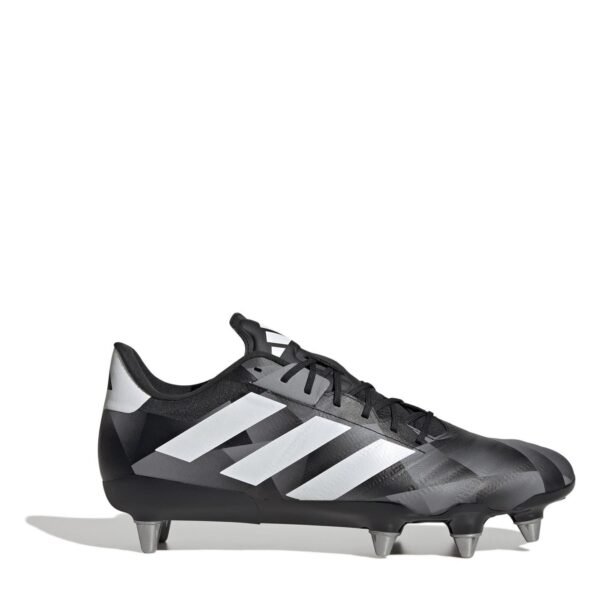 Adidas Kakari RS Soft Ground Rugby Boots – Black/Whitefrom £96.50
 Adidas Kakari Soft Ground Rugby Boots – White/Blackfrom £40.00
 Adidas Kakari Soft Ground Rugby Boots – Blk/Wht/Crbnfrom £58.00
 Adidas Kakari Soft Ground Rugby Boots – Lucid Redfrom £36.00
 Adidas Kakari RS Soft Ground Rugby Boots – Black/SilverNo offers today
Before you buy
Check the surface. Every Kakari is a soft-ground boot, built for soft, wet natural grass. They are not intended for dry, hard pitches or artificial surfaces — check adidas' guidance on suitable surfaces first. Our guide to firm ground vs soft ground rugby boots explains when each makes sense.
Check the size run. adidas builds its senior boots UK 6 to UK 15 in every colourway — what varies is which of those sizes the retailers we compare have in stock. The size you need often decides which colourway you end up with.
Frequently asked questions
What are the best adidas rugby boots for a prop?
The Kakari line, because the eight-stud outsole is built for exactly the job a prop does. Which tier depends on how often you play: the standard Kakari for occasional rugby, the Elite for weekly club rugby, the RS at the top level.
Do forwards need eight-stud boots?
For the tight five, eight studs give measurably more grip and a more stable platform when scrummaging. Back-row forwards often prefer a six-stud boot for mobility. It comes down to how much of your game is spent driving versus running.
Can a forward wear RS15 boots?
Back-row forwards commonly do, since they cover similar ground to the backline. For the front five it means giving up the anchor points the set piece depends on.
Are Kakari boots suitable for artificial grass?
They are built with soft-ground outsoles for soft, wet natural grass. Check adidas' guidance on suitable surfaces before using them on artificial turf or hard ground.
Related guides
- The adidas Kakari range explained
- adidas RS15 vs Kakari
- Best Rugby Boots for a Forward
- Rugby Boot Size Guide
RugbyDeals helps you compare prices across the retailers and products we feature on our site. Prices and stock can change, so always confirm the final details on the retailer's site before buying. Our content is for general information only and isn't safety, medical or buying advice — always follow the manufacturer's guidance and speak to a professional where it matters. We may earn a commission when you buy through our links, at no extra cost to you.